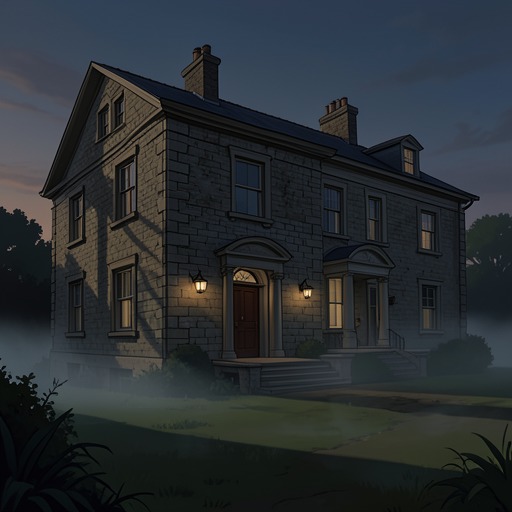
Nancy Drew takes up the Turnbull mansion mystery
The Hidden StaircaseNancy Drew takes up the Turnbull mansion mystery when the Turnbull sisters’ fear of their old family home collides with Nancy’s willingness to investigate it. What first appears to be a haunting consists of noises, shadows, music, and missing possessions; Nancy’s proposed search for secret panels and trapdoors redirects the sisters’ distress toward a material explanation. Her undertaking ultimately leads into a wider conflict involving Nathan Gombet, but the case also shows that suspicion alone is not enough: Nancy must persuade the sheriff that the accusations can be supported by evidence.
Background: A house under pressure
Rosemary Turnbull explains that she and her twin sister, Floretta Turnbull, have lived in The Mansion for thirty years without disturbance until the recent weeks of strange events. The house is old, its original stone walls preserved through repeated remodeling, and it has remained in the Turnbull family. Its history and age make a ghost story imaginable, but Rosemary does not accept that explanation as fact. She is troubled by what is happening even as she resists calling it supernatural.
The sisters’ account accumulates specific disturbances. They hear noises throughout the house, not only in the attic. Floretta thinks she once saw a human shadow; Rosemary adds that shadows appear on the walls at night. One recent night, Rosemary distinctly hears someone playing a stringed instrument. These incidents unsettle the household in different ways: Floretta becomes so anxious that she says she cannot stay another week, while Rosemary grows afraid to sleep in her own bed. Floretta wants Rosemary to agree to sell the house, but Rosemary does not want to surrender a home held by her family for decades.
The apparent haunting is accompanied by losses that make a purely supernatural account less persuasive. The sisters first notice that a silver spoon is missing. They search for it, but the loss does not initially seem decisive; concern sharpens when they also discover that a pocketbook is gone. The objects turn the case from an atmosphere of unexplained sounds into a question of access and theft. For Rosemary, the shadows remain the most frightening element, but the missing belongings give Nancy a concrete problem to investigate.
Nancy accepts the investigation
Abigail Rowen confidently assures Rosemary that Nancy will help. Nancy herself is more measured: she is interested in the story and would like to visit The Mansion, but initially expresses doubt about whether she can solve it. Rosemary’s urgent appeal and the possibility of examining the house move the conversation toward a commitment. Nancy does not promise a solution; she agrees to do her best.
At The Mansion, Nancy identifies a practical first step. She intends to go through the house and look for secret panels or trapdoors, treating concealed architecture as a possible explanation for events that have seemed to occur without an apparent cause. Floretta is pessimistic and says she has never heard of such features in the house. Nancy nevertheless considers the search worthwhile. Her approach changes the sisters’ immediate circumstances even before it yields an answer: Nancy’s arrival has a wholesome effect, and the two women become more cheerful. Floretta gets up, dresses, and comes downstairs for luncheon in markedly better spirits than her sister expected.
The contrast between the sisters’ fear and Nancy’s method gives the investigation its initial direction. The house is neither dismissed as ordinary nor declared haunted; instead, Nancy treats its unexplained spaces as something that can be examined. The search she proposes is specific to the setting: an old house whose original walls remain beneath later remodeling, and whose residents have experienced disturbances in multiple parts of it. The available account establishes her intention and its reassuring effect, without detailing the full search or every discovery that follows.
The Gombet connection and the demand for proof
A separate dispute supplies important context for Nathan Gombet’s later role. Carson Drew recalls that Gombet’s land was condemned for a railroad right of way and that Carson, while serving on the land commission, saw to it that Gombet was well paid. Gombet initially appeared satisfied with the arrangement. After the bridge was built, however, he pressed the commission for more money, arguing that the bridge had damaged the remainder of his property. Carson regarded those claims as ridiculous and described Gombet as a sorehead. He had also heard that Gombet spoke of blowing up the bridge and decided he should keep an eye on him.
Gombet later gives the grievance a more explicit form: he says he was cheated because his land was worth several times what he received and demands either the deed back or his price. This establishes a conflict over compensation, but it does not by itself establish responsibility for the sisters’ experiences or their missing property. The distinction matters as Nancy moves from investigating suspicious events to naming a suspect. A grievance may suggest a motive; it is not, on its own, proof of a crime.
When Nancy eventually asks the sheriff to arrest Gombet, she reports the strange events and the discoveries she has made, with Rosemary and Floretta corroborating her account. She states that Gombet is guilty. The sheriff says he believes their story, but refuses to proceed without evidence and points to the silver urn as an example of the kind of proof that would matter if it were found in Gombet’s house. The exchange makes the legal threshold part of the mystery’s resolution: belief in Nancy’s account and a willingness to investigate are not identical to grounds for arrest.
Consequences and significance
The case’s wider stakes become clear when Carson explains that Gombet induced him to come to the house by trickery and held him for several days while trying to force him to sign over money. A paper found on the table is identified as the agreement Gombet wanted Carson to sign: Carson would hand over a large sum and promise not to prosecute. Gombet’s earlier claim that he was owed compensation thus stands in sharp contrast to the later attempt to obtain money through coercion. The dispute over what he believed he was owed does not justify the means he uses.
Nancy’s decision to take up the Turnbulls’ case therefore begins with a family’s threatened security and an apparent haunting, but the eventual disclosures connect the investigation to theft, an unresolved grievance, and Carson’s captivity. The supplied account does not describe every step between Nancy’s proposed search and the later confrontation; it does establish the progression from unexplained disturbances to a demand for an arrest, and then to concrete evidence of Gombet’s attempted extortion. The sheriff’s insistence on proof provides a counterweight to Nancy’s certainty, while Carson’s account and the written agreement supply a firmer basis for action.
The episode’s central reversal is from supernatural appearance to human agency. No ghost is established: noises, shadows, and music initially frighten the sisters, while the missing spoon and pocketbook invite investigation. Nancy’s response is not to dismiss their fear, nor to accept the haunting as an explanation, but to search for a hidden physical cause. By taking the case seriously and pursuing evidence, she turns the old house from a place the sisters may have to abandon into the center of an investigation that exposes a criminal threat.